September 2026 – The decision is sensible, yet it came as a surprise: the US Federal Reserve has raised key interest rates. In mid-September, rates rose by 0.25 percentage points to a range of now 3.75 to 4 percent. The hike is justified because inflation in the US has risen significantly for some time. In August, it stood at 3.6 percent, matching the previous month. Critics warn of inflation becoming entrenched, which could have significant negative impacts on consumption in the medium term. Nevertheless, the hike is highly controversial, especially in politics. Leading the charge, US President Donald Trump reacted aggressively and suspects a conspiracy – understandable, as his popularity among Americans is clearly waning. This presents a major problem, as the midterm elections are approaching in November. Although voting is not directly for the office of the US President, but rather for the composition of the Senate and the House of Representatives, the midterms are regarded as an important litmus test for Trump's policies. Rising interest rates, however sensible they may be, do not fare well in such an environment.
That is one side of the story. On the other hand, despite growing uncertainties for the equity market, many companies in the US are currently convincing with strong numbers and outlooks. The second-quarter earnings season in the US was one of the best in recent decades. Earnings in the S&P 500 are around 50 percent above the level of the second quarter of 2025. Although this strong increase is partly distorted by booking effects in the quarterly earnings of Alphabet and Amazon, even after adjusting for this influence, the earnings growth in the second quarter still stands at approximately 30 percent.
The "defenders" are becoming fewer
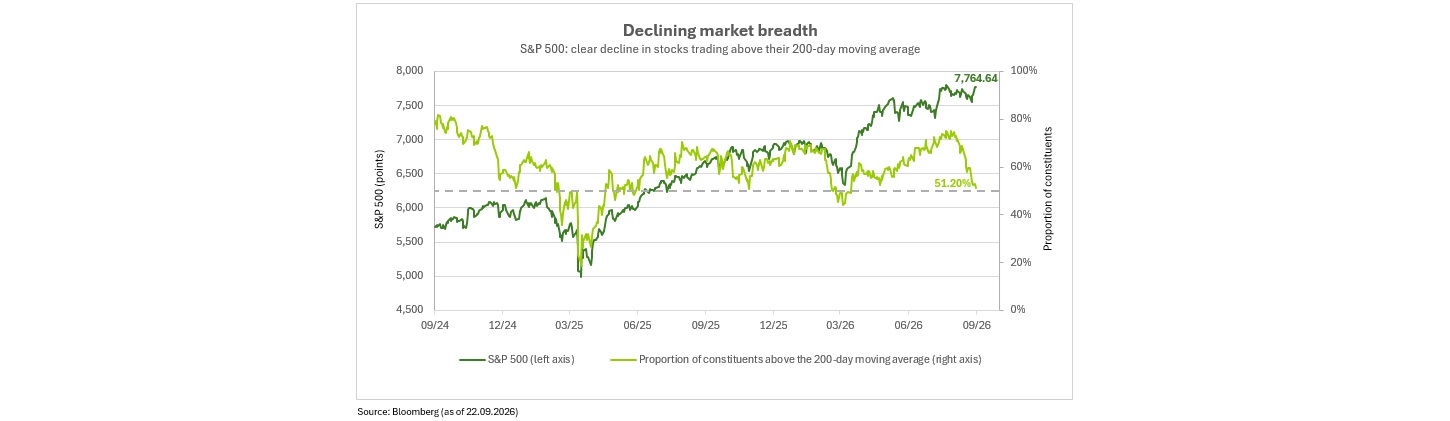
It is therefore obvious that US companies are doing well, which is also reflected in share prices. Benchmark indices such as the Dow Jones and the S&P 500 have reached record levels during the year, which they have been bravely defending for several months now. However, a development has recently emerged that should make investors more cautious: the market breadth of the "defenders" of these record levels is declining. The number of S&P stocks trading above their 200-day moving average has been declining significantly for some time. By mid-September, only about half of the S&P securities were trading above this level (see graph). By comparison, in July and August, over 70 percent of stocks were trading above their 200-day moving average.